
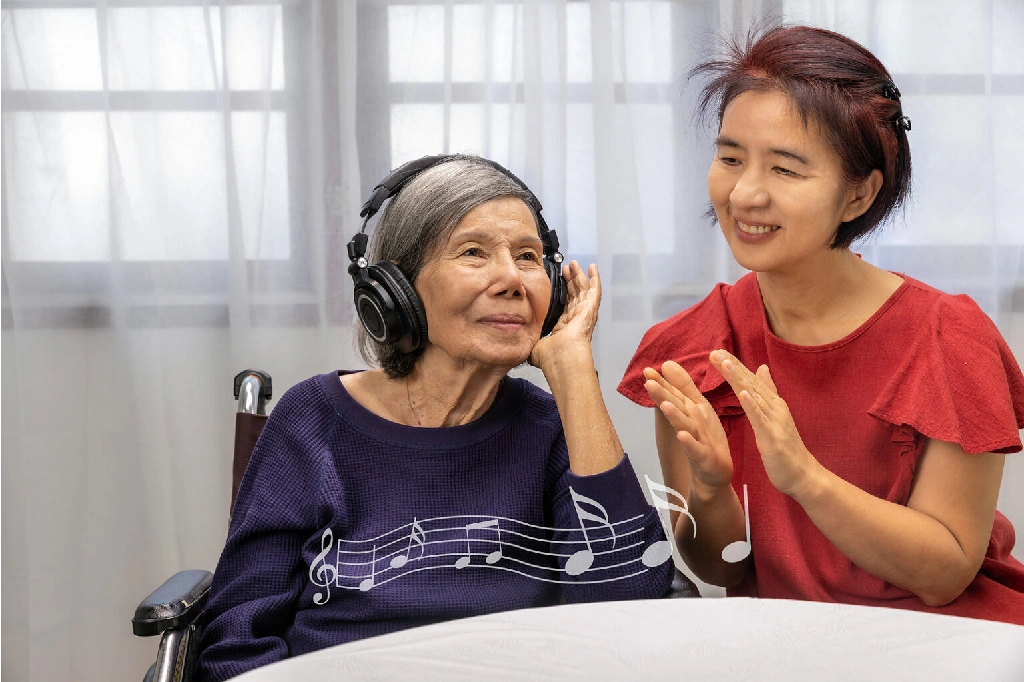
There is a moment that caregivers and family members describe again and again. A person with advanced dementia, largely withdrawn from conversation and unresponsive to much of what goes on around them, hears a familiar song and comes alive. They start mouthing the words. Sometimes they sing. Their face changes. For a few minutes, they are present in a way they have not been in weeks.
This is not just anecdotal. The science behind why music affects people with dementia the way it does is increasingly well understood, and the evidence for its clinical benefits has grown substantially over the past decade.
Why Music Reaches the Brain Differently
To understand why music works in dementia, it helps to understand which parts of the brain it activates and why those parts tend to be spared longer than others.
Dementia, particularly Alzheimer’s disease, damages the brain in a somewhat predictable pattern. The hippocampus, which is responsible for forming new memories, is among the first structures affected. The regions of the cortex responsible for language, spatial reasoning, and executive function are progressively damaged as the disease advances. But the areas of the brain that process music, particularly familiar music with strong emotional associations, are distributed differently and appear to be more resistant to the early and middle stages of neurodegeneration.
Musical memory, specifically the ability to recognize and emotionally respond to music heard many times over a lifetime, involves structures including the basal ganglia, the cerebellum, and the supplementary motor cortex, as well as emotional processing centers like the amygdala. These regions are relatively preserved in Alzheimer’s disease compared to the areas responsible for episodic and semantic memory. This is why a person who cannot remember what they had for breakfast may be able to sing every word of a song from their twenties. The two types of memory rely on different neural architecture, and the music-related architecture tends to hold up longer.
What the Research Actually Shows
The clinical evidence for music therapy in dementia has grown considerably, and several high-quality systematic reviews and meta-analyses now summarize the findings across dozens of randomized controlled trials.
A 2025 meta-analysis published in Dementia and Geriatric Cognitive Disorders by Lu and colleagues analyzed 24 randomized controlled trials comparing music therapy to standard care in people with dementia. The results showed that patients who received music therapy had higher cognitive function scores, lower levels of depression, and lower levels of anxiety compared to control groups. The authors noted that the effects were present across different types of music interventions, including both active participation, such as singing and playing instruments, and receptive listening.
A systematic review published in Aging and Mental Health found similar results, reporting benefits to cognitive function, behavioral and psychological symptoms, and quality of life. Behavioral and psychological symptoms of dementia, known in the clinical literature as BPSDs, include agitation, aggression, anxiety, depression, and wandering. These symptoms are among the most distressing aspects of dementia for both patients and caregivers, and pharmacological management carries significant risks in older adults. The evidence that music therapy can reduce these symptoms meaningfully, through a safe, non-invasive, and low-cost intervention, is clinically relevant.
A 2025 systematic review published in a peer-reviewed geriatrics journal, which followed PRISMA guidelines and covered studies published between 2013 and 2023, evaluated music interventions specifically in adults aged 65 and older with various types and stages of dementia. It concluded that both structured music therapy and music-based activities more broadly were effective in reducing agitation, depression, and anxiety, reinforcing what the earlier meta-analyses found.
It is worth being clear about what music therapy is in a clinical sense. Formal music therapy is delivered by a credentialed music therapist who designs interventions based on the individual’s history, preferences, and clinical needs. This is distinct from simply playing music in a care environment, though there is evidence that personalized music listening, even without a trained therapist present, produces meaningful benefits. The distinction matters because the quality and individualization of the intervention affects outcomes.
Why Familiar and Personally Meaningful Music Matters
Not all music produces the same effect. The research consistently points to familiar, personally meaningful music as the most effective category, meaning songs from a person’s young adulthood and middle age that carry strong autobiographical or emotional associations.
This makes sense neurologically. When a person hears a song they have heard hundreds of times throughout their life, the brain is not just processing sound. It is activating a network of associations, emotions, and implicit memories that have been consolidated over decades. These long-established associations are encoded more deeply than recent memories and draw on neural pathways that dementia damages more slowly.
A 2023 systematic review published in Alzheimer’s Research and Therapy by Bleibel and colleagues, which reviewed randomized controlled trials of music therapy specifically in Alzheimer’s disease, found that music interventions produced improvements in global cognition, memory, verbal fluency, and attention. The review also noted improvements in behavioral symptoms and emotional well-being. The authors emphasized that the personalization of music selection, based on the individual’s own history and preferences, was a consistent feature of the most effective interventions.
The practical implication for families is that a playlist matters. A generic compilation of classical music or songs from a particular decade is less likely to be effective than music specifically chosen because it meant something to that particular person. Getting input from family members about what the person loved to listen to at different points in their life is a meaningful contribution to their care.
What Music Does Beyond the Moment
One of the more interesting findings in the research is that the benefits of music therapy are not always limited to the duration of the intervention itself. Several studies have found that regular music therapy produced improvements in mood and behavioral symptoms that persisted beyond individual sessions. This suggests that the effects are not simply a matter of pleasant distraction during the activity but may involve more lasting changes in arousal regulation, mood state, and social engagement.
Music also appears to function as a social bridge. Group music activities, singing together, rhythm exercises, or simply listening in the company of others create shared experiences that facilitate connection between people who may have limited verbal communication. The communication post published earlier in this series noted that non-verbal connection remains possible well into the advanced stages of dementia. Music is one of the most powerful facilitators of exactly that kind of connection.
The Limits of What the Research Shows
The evidence for music therapy in dementia is genuinely encouraging, but some caveats are worth naming.
The quality and design of studies in this area varies considerably. Many trials are small, and the heterogeneity across studies in terms of intervention type, duration, population, and outcome measures makes direct comparisons difficult. Several meta-analyses note that while the direction of findings is consistently positive, the strength of the evidence is moderate rather than definitive.
Music therapy is also not a treatment for the underlying disease. It does not slow neurodegeneration or reverse cognitive decline. What the evidence supports is that it reduces behavioral and psychological symptoms, improves mood and quality of life, and provides a form of meaningful engagement that other interventions cannot easily replicate. That is a meaningful clinical contribution, even if it is not a cure.
What Families Can Do With This
You do not need a credentialed therapist to apply what the research tells us. Playing a loved one’s favorite music regularly, building a playlist based on what they loved at different points in their life, singing familiar songs together, and paying attention to how they respond to different music are all practical steps that are grounded in the science.
Pay attention to the response. Some people with dementia find certain types of music overstimulating rather than calming, particularly in later stages when sensory processing is impaired. The goal is engagement and calm, not performance or correction. If a person is tapping their foot, mouthing words, or simply looking more relaxed and present, the music is doing something useful.
For families exploring formal care settings, asking about whether and how music is incorporated into daily programming is a reasonable question. The evidence supports it as a meaningful component of quality dementia care, not an optional add-on.
This post connects naturally to our earlier piece on how dementia affects communication, which covers why non-verbal connection remains possible even in the later stages of the disease and how music functions as one of the most effective bridges to that connection.
Have questions about memory care for a loved one?
We are happy to talk. Whether you are just starting to research your options or are further along in the process, feel free to call us, send an email, or schedule a tour of our home. No pressure, just a straightforward conversation.
463-444-9064 | Ben@HonorHavenSeniorLiving.com | Schedule a Tour
Sources
– Lu LC, Lan SH, Lan SJ, Hsieh YP. Effectiveness of the Music Therapy in Dementia: A Systematic Review and Meta-Analysis of Randomized Controlled Trials. Dementia and Geriatric Cognitive Disorders. 2025;54(3):167-186.
– Bleibel M, El Cheikh A, Said Sadier N, Abou-Abbas L. The effect of music therapy on cognitive functions in patients with Alzheimer’s disease: a systematic review of randomized controlled trials. Alzheimer’s Research and Therapy. 2023;15(1):65.
– Fusar-Poli L, et al. The effect of music therapy on cognitive functions in patients with dementia: a systematic review and meta-analysis. Aging and Mental Health. 2018;22(9):1097-1106.
– Neha, et al. The effects of music interventions on behavioural and psychological symptoms in older adults with dementia: systematic review. Aging and Mental Health. 2025.
– Särkämö T, et al. Cognitive, emotional, and social benefits of regular musical activities in early dementia. Gerontologist. 2014;54(4):634-650.
– Alzheimer’s Association. 2024 Alzheimer’s Disease Facts and Figures. Alzheimer’s & Dementia. 2024.