
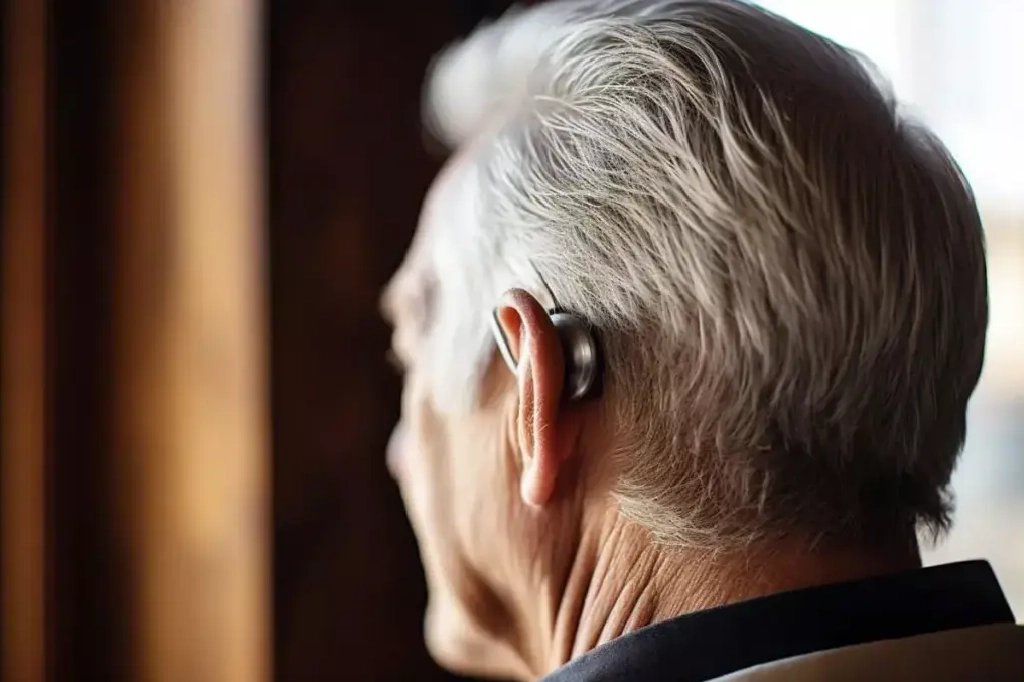
Hearing loss is one of those things most people accept as an inevitable part of getting older. Someone turns the television up, asks people to repeat themselves, stops going to restaurants because the noise makes conversation impossible. Family members find it mildly frustrating. Almost no one treats it as a medical priority.
The research over the past decade suggests that is a mistake. Hearing loss is now recognized as one of the largest modifiable risk factors for dementia, and the reasons it matters are more interesting than most people expect.
What the Evidence Shows
The 2024 Lancet Commission on Dementia Prevention, the most authoritative ongoing review of dementia risk factors, includes hearing loss among the 14 modifiable factors that together account for nearly half of global dementia cases. Of those 14 factors, hearing loss carries one of the largest attributable fractions. The Commission has estimated that roughly 7 to 8% of global dementia cases are attributable to hearing loss, making it among the single largest contributors on the list.
Observational research supports this. Population-based studies have consistently found independent associations between hearing impairment and both accelerated cognitive decline and increased dementia incidence. Some studies have estimated that hearing impairment is associated with a substantially increased risk of incident dementia, with one frequently cited figure being a 94% increased risk in population-based observational data.
Hearing loss is also extremely common. The ACHIEVE study researchers note that hearing loss is present in roughly 65% of adults over age 60. This is not a rare condition affecting a small subgroup. It is a nearuniversal feature of aging that most people leave untreated.
Why Hearing Loss Might Cause Cognitive Decline
Researchers have proposed several mechanisms, and they are not mutually exclusive.
Cognitive load. When hearing is impaired, the brain has to work considerably harder to decode speech. Resources that would normally be available for comprehension, memory encoding, and reasoning are diverted to the basic task of figuring out what was said. Over years, this sustained reallocation may deplete the cognitive reserve that would otherwise buffer against neurodegeneration
Reduced auditory input and brain structure. Neuroimaging research has found that people with hearing loss show accelerated atrophy in the temporal lobe regions that process sound and language. The brain appears to reorganize in response to reduced input, and the regions involved overlap substantially with those affected early in Alzheimer’s disease.
Social isolation. This may be the most important pathway. People with untreated hearing loss withdraw from conversation, avoid group settings, and gradually disengage from social life because participation becomes exhausting and embarrassing. Social isolation is itself an established dementia risk factor, and hearing loss is one of the most common routes into it. The mechanism here is indirect but potentially substantial.
Shared underlying causes. It is also possible that some of the association reflects common causes rather than causation. Microvascular disease, for example, can damage both the inner ear and the brain. Researchers have been careful to note that observational associations cannot fully rule out this explanation.
The ACHIEVE Trial: What Happened When They Tested It
The obvious question is whether treating hearing loss reduces dementia risk. Observational data cannot answer that. A randomized controlled trial can.
The ACHIEVE trial, published in The Lancet in 2023, was the largest randomized controlled trial to date examining this question. Researchers enrolled 977 adults aged 70 to 84 with untreated mild to moderate hearing loss and no dementia, and randomized them to either a best-practices hearing intervention involving hearing aids and audiologic rehabilitation, or to a health education control program. They then measured cognitive decline over three years.
The headline result was negative. Across the full study population, the hearing intervention did not significantly reduce three-year cognitive decline compared to the control group.
But the more interesting finding came from a prespecified subgroup analysis. The trial enrolled participants from two sources: a group recruited from the Atherosclerosis Risk in Communities study, who were older and had more cardiovascular risk factors and therefore a higher baseline risk of cognitive decline, and a group of healthy volunteers recruited from the community, who were generally healthier and at lower risk.
In the higher-risk group, hearing intervention reduced cognitive decline by approximately 48% over three years compared to the control condition. In the healthy volunteer group, there was no significant effect.
A 2025 secondary analysis published in Alzheimer’s & Dementia examined this pattern more systematically. The researchers built a predictive model of cognitive decline risk using data from nearly 2,700 dementiafree participants and applied it to the ACHIEVE population. The analysis confirmed that the cognitive benefit of hearing intervention varied by baseline risk, with greater benefit concentrated among those at higher risk of decline.
How to Interpret This Honestly
The ACHIEVE results have been reported in both directions, sometimes as proof that hearing aids prevent dementia and sometimes as proof that they do not. Neither framing is accurate.
What the trial actually showed is that hearing intervention did not slow cognitive decline in a generally healthy older population over three years, but did appear to produce substantial benefit in people who were already at elevated risk. There are a few reasonable interpretations. The healthy volunteers may have had cognitive decline rates too low over three years for any intervention to show measurable effect. Three years may simply be too short a window to detect prevention of a disease that develops over decades. Or the benefit may genuinely be concentrated in people whose brains are already under strain from other risk factors.
A 2024 systematic review and meta-analysis published in Ageing Research Reviews examining adult-onset hearing loss and incident cognitive impairment noted this interpretive difficulty directly, acknowledging that while observational associations are consistent, experimental evidence remains limited and the causal question is not fully resolved.
Separately, a meta-analysis published in JAMA Neurology found that hearing aid use was associated with a 19% reduction in long-term incidence of cognitive decline compared to uncorrected hearing loss, drawing on observational data across multiple studies.
The honest summary is that hearing loss is clearly associated with dementia risk, that the biological mechanisms are plausible, that treating it appears to help meaningfully in at-risk populations, and that the evidence for prevention in healthy older adults is not yet definitive.
Why This Still Matters Practically
Even setting aside the dementia question, the case for treating hearing loss is strong.
Untreated hearing loss is associated with social withdrawal, depression, reduced quality of life, increased fall risk, and communication breakdown within families. These are significant outcomes on their own. The possible cognitive benefit is an additional reason, not the only one.
For someone who already has dementia, hearing loss compounds the problem substantially. A person who cannot hear well and cannot process language well is operating at a severe disadvantage. Correcting the hearing component does not treat the dementia, but it removes one obstacle to communication, reduces confusion, and can meaningfully improve engagement and reduce agitation. Research presented in 2025 examined over-the-counter hearing aids specifically in adults with cognitive decline due to Alzheimer’s disease and related dementias, reflecting growing clinical interest in this population.
It is also worth noting that hearing aids have become substantially more accessible. Over-the-counter hearing aids became available in the United States in 2022 following an FDA rule change, dramatically reducing cost and eliminating the requirement for a medical exam for adults with perceived mild to moderate hearing loss.
What to Do With This
If you or a family member has noticed hearing difficulty, getting an audiologic evaluation is a reasonable step regardless of the dementia question. Hearing loss develops gradually enough that most people significantly underestimate their own impairment.
If you are caring for someone with dementia, check whether their hearing has been evaluated. Hearing loss in this population is frequently missed because the communication difficulties get attributed entirely to the dementia. Confirming that someone can actually hear before concluding they cannot understand is a basic and frequently skipped step.
And if hearing aids have been prescribed but are sitting in a drawer, that is worth addressing. The most common reason hearing aids fail to help is that they are not worn, often because of fit, discomfort, or difficulty managing them. An audiologist can usually resolve these issues.
Hearing loss appears to affect dementia risk partly through social isolation. Our post on loneliness as a medical risk factor for dementia covers that pathway in detail, including the biological mechanisms through which social disconnection affects the brain.
Have questions about memory care for a loved one?
We are happy to talk. Whether you are just starting to research your options or are further along in the process, reach out anytime.
463-444-9064 | Ben@HonorHavenSeniorLiving.com | Schedule a Tour
Sources
- Lin FR, Pike JR, Albert MS, et al. Hearing intervention versus health education control to reduce cognitive decline in older adults with hearing loss in the USA (ACHIEVE): a multicentre, randomised controlled trial. The Lancet. 2023;402(10404):786-797.
- Huang AR, et al. Cognitive benefits of hearing intervention vary by risk of cognitive decline: A secondary analysis of the ACHIEVE trial. Alzheimer’s & Dementia. 2025;21(5):e70156.
- Yeo BSY, et al. Association of Hearing Aids and Cochlear Implants With Cognitive Decline and Dementia: A Systematic Review and Meta-analysis. JAMA Neurology. 2023;80(2):134-141.
- Livingston G, et al. Dementia prevention, intervention, and care: 2024 report of the Lancet standing Commission. The Lancet. 2024;404(10452):572-628.
- Griffiths TD, Lad M, Kumar S, et al. How Can Hearing Loss Cause Dementia? Neuron. 2020;108(3):401- 412.
- Adult-onset hearing loss and incident cognitive impairment and dementia: A systematic review and metaanalysis of cohort studies. Ageing Research Reviews. 2024;98:102346.